
News

Join Dr. Judy Z. Stephenson in her latest tea break discussions with UCL scholars: Excluded workers and human rights; How to prevent disasters; Rethinking Britain in India; and Jeremy Bentham, the British philosopher, economist, jurist, legal reformer and founder of modern utilitarianism.

What begins with a silent home movie of the Glorious Twelfth unfolds into a reflection on faith, belonging, and the long arc of peace. Through family history and Belfast’s hard-won lessons, Dr. Laurence B. Mussio argues in The Globe and Mail that reconciliation is not betrayal—it is an act of courage.

LRI Director and UCL professor Judy Stephenson continues her engaging dialogues with leading UCL scholars, inviting viewers to connect with some of today’s most compelling academic voices.

In this new University College London Press series, host and LRI Director Judy Stephenson asks 10 serious questions of some of UCL’s leading academics. Over this particular cup of tea, Professor Stephenson explores the human-AI connection with anthropology Professor Daniel Miller. Noting that AI is becoming increasingly anthropomorphised, the discussion explores how we assign meaning and value to technology as we integrate it ever more deeply into our lives.

Writing in the World Commerce Review, Dr. Laurence B. Mussio and Dr. Paul Samson argue that global power increasingly hinges on who controls the ledger—the infrastructure that records and settles financial value. From ancient Sumer to the Medici bankers to SWIFT, ledgers have always been instruments of authority. Today, that contest is being rewritten through stablecoins, tokenized assets, and central bank digital currencies. Do nations that fail to control their own digital monetary architecture risk losing sovereignty—perhaps permanently?

Canada is moving away from heavy dependence on the United States by rebuilding domestic defence production and helping create a new multinational “defence bank” meant to fund long term military capacity across democratic allies. Writing in The Globe and Mail, Dr. Laurence B. Mussio and Dr. Jessica M. Lomas analyze this shift in Canadian defence strategy. They look at what it is, why it’s needed and Canada’s role, examining the historical echoes and the challenges ahead.
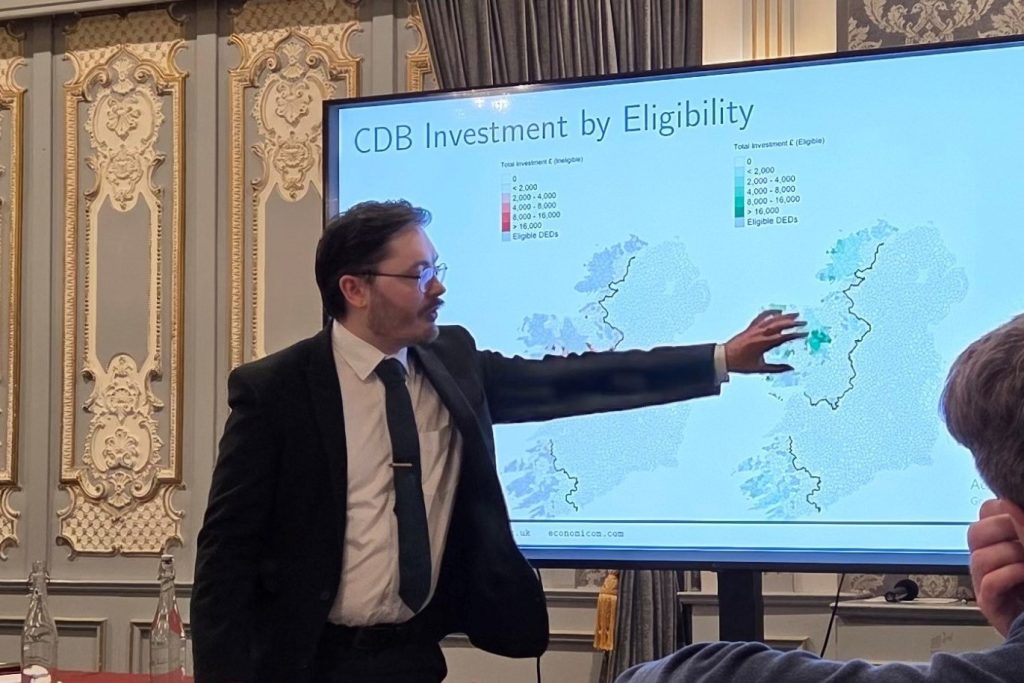
Our congratulations go to LRI Senior Research Fellow Dr. Tiarnán Heaney who was awarded the Conniffe Prize at this year’s Irish Economic Association conference for the best paper by a young economist.
His study of an early Irish development agency shows how smart place based policy reduced poverty in the west of Ireland by transforming agricultural practices and increasing capital investment. The takeaway: real regional development means expanding opportunity where people already are.
Comhghairdeas Dr. Heaney!

In this op-ed, Laurence Mussio recalls his father, an Italian immigrant who worked as a boilermaker and believed deeply in the postwar promise of Canada: that hard work would build lasting institutions and a better future for later generations. The author argues that this intergenerational bargain has broken down. Canada, he says, is now losing capital, talent, and competitiveness, while its institutions have become slow, indecisive, and unable to execute. Drawing historical parallels, he suggests the country still has the tools to renew itself if institutions and leaders choose to act decisively.

Writing in The Globe and Mail, Dr. Laurence B. Mussio and Dr. Jessica M. Lomas show how the crisis in the Strait of Hormuz is not primarily military — it is an insurance driven shutdown of global maritime trade. War risk insurers withdrew coverage so quickly after the first U.S.–Israeli strikes that the strait effectively closed before any naval blockade was declared. The authors explore the deeper meaning of a global system built to “remember” past risks — symbolized by Lloyd’s Loss Book —failing to prevent a modern cascade.

The Long Run Institute is delighted to have co sponsored the Economic History Society’s Centenary Conference at the LSE in April 2026, where global scholars presented research on migration, labour, trade, gender, and more. LRI directors Judy Stephenson and John Turner chaired key sessions, while Michael Aldous and Tiarnán Heaney each presented papers. The LRI salutes its contributors and congratulates the Society on its hundred years.