
Economic Development & Productivity
Events

December 2023 – January 2024 | Toronto, London, New York
The LRI recently held a series of three invitation-only roundtables in partnership with the Ian O. Ihnatowycz Institute for Leadership, Ivey Business School. The series focused on the challenges facing executives and policy makers vis-à-vis purpose, character and leadership in relation to ESG and the future of work, with the LRI contributing insights from the long-run experience.

A roundtable discussion on the unravelling of globalization, xenophobic resentment stoked by domestic inequality and rising costs of living, and national policy makers campaigning to “take back control” of borders. Political and economic experts from Canada and Ireland examined how to make sense of these developments, and how policy makers, businesses, and citizens could respond.
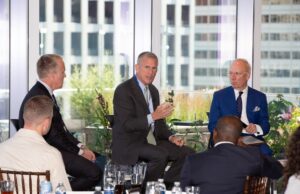
A day of discussion on the events and cycles underpinning risk with keynote guests General Stanley McChrystal, former Director of the Joint Chiefs of Staff, Professor Juliette Kayyem, Belfer Senior Lecturer in International Security at Harvard’s Kennedy School of Government, and leading international economist Dr. Nouriel Roubini of NYU’s Stern School of Business.
Articles

The Swedish deal, the defence bank and the West’s awakening from its long dream
Canada is moving away from heavy dependence on the United States by rebuilding domestic defence production and helping create a new multinational “defence bank” meant to fund long term military capacity across democratic allies. Writing in The Globe and Mail, Dr. Laurence B. Mussio and Dr. Jessica M. Lomas analyze this shift in Canadian defence strategy. They look at what it is, why it’s needed and Canada’s role, examining the historical echoes and the challenges ahead.
LRI Research Fellow wins award
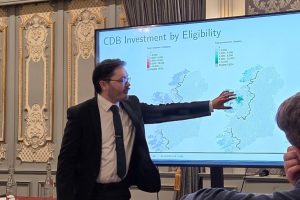
Our congratulations go to LRI Senior Research Fellow Dr. Tiarnán Heaney who was awarded the Conniffe Prize at this year’s Irish Economic Association conference for the best paper by a young economist.
His study of an early Irish development agency shows how smart place based policy reduced poverty in the west of Ireland by transforming agricultural practices and increasing capital investment. The takeaway: real regional development means expanding opportunity where people already are.
Comhghairdeas Dr. Heaney!

The LRI at the EHS Centenary Conference
The Long Run Institute is delighted to have co sponsored the Economic History Society’s Centenary Conference at the LSE in April 2026, where global scholars presented research on migration, labour, trade, gender, and more. LRI directors Judy Stephenson and John Turner chaired key sessions, while Michael Aldous and Tiarnán Heaney each presented papers. The LRI salutes its contributors and congratulates the Society on its hundred years.